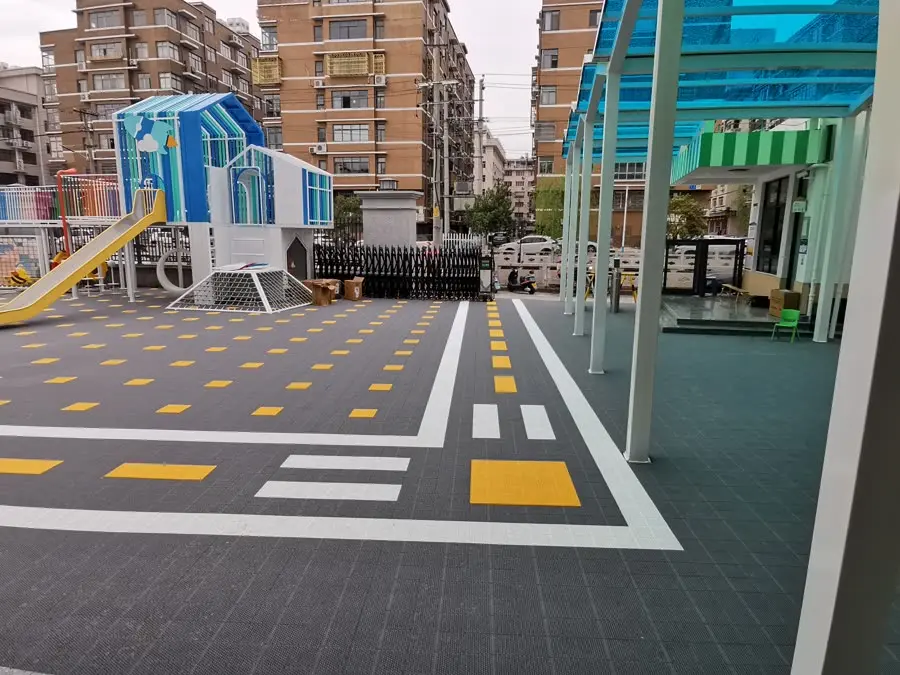
What is the difference between suspended interlocking flooring and acrylic courts?
Author: Ian | CTO
A comprehensive comparison of suspended interlocking flooring vs. acrylic-coated courts. A detailed breakdown across 6 dimensions: installation, maintenance, drainage, sports experience, lifespan, and cost.
Short answer:Suspended interlocking flooring and acrylic courts areTwo completely different sports flooring systems. Suspended flooring isModular interlocking assembly(PP single-tile on-site assembly), while acrylic isOn-site coating system(multiple coats applied over the base). Core differences: suspended flooring installs fast (2–3 days vs 10–15 days), drains well (raised underside vs surface runoff), is easy to repair (local replacement vs full recoating); acrylic has a low initial cost (80–120 yuan/㎡ vs 120–280 yuan/㎡) and a strong sense of unity (no seams vs seams).
Multi-functional court (multi-sport compatible / flexible single-tile line splicing)
Tight schedule / short installation window
Possible future renovation / relocation
Sensitive to long-term maintenance costs
Choose an acrylic court
Tight budget in the early stage (< 150 RMB/㎡)
Pursuing a seamless integrated feel
Professional tennis court (ITF certified)
Indoor sites that do not require rapid drainage
Already has a good-quality silicon PU base (can be recoated and renovated)
Common misconceptions
Myth 1: "Acrylic is professional; suspended flooring is amateur"
Not necessarily. Acrylic's strength is tennis courts (the ITF global tennis court certification standard uses acrylic); suspended flooring's strength is basketball, 3x3 basketball (3-on-3 basketball scenario), and multi-purpose courts. Both have professional certified use cases,Depends on the sport。
Myth 2: "Seams in suspended flooring mean it's inferior"
Seams are a structural feature of suspended flooring (for drainage + thermal expansion/contraction + localized repair), not a sign of poor quality. Large-format ANK5/ANK6 (50×50cm) have a very low seam feel, with a look close to a continuous surface.What really affects the sports experience is not the presence of seams, but whether the individual tiles are level and the locks are secure。
Myth 3: "Acrylic is naturally good at slip resistance"
Not necessarily. Acrylic's anti-slip performance depends onMortar particle top coat, and after 2–3 years of mortar wear, the anti-slip performance declines markedly. The anti-slip property of suspended flooring is structural (such as Interstellar's Anti-Slip granular dot design) and does not weaken over the long term.
Recommendations for specific scenarios
Campus basketball court: The top choice for suspended flooring. Reasons: 1)GB 36246-2018 Mandatory Requirements, suspended flooring has higher testing coverage; 2) installation takes 2–3 days without disrupting teaching; 3) the 8-year warranty period spans a student's entire academic stage.
Kindergarten Activity Areas: The top choice for suspended flooring. Reasons: 1) flexible color inlay patterns; 2) locally damaged tiles can be replaced individually without affecting overall use; 3) a wide selectable range of impact absorption (see Kindergarten special section)。
Professional tennis court: acrylic is the top choice. Reason: the ITF global tennis court standard certification uses acrylic systems, and the overall flat, seamless surface meets tennis landing-point judgment requirements.
Community multi-purpose court: The top choice for suspended flooring. Reasons: see Community multi-purpose court feature, a comprehensive consideration of multi-project compatibility + easy maintenance + long lifespan.
FAQ
Can Suspended Flooring Be Laid Directly Over an Acrylic Surface?
Yes, provided the original acrylic surface is flat and free of large-area bulging or delamination.No need to remove the acrylic coating, and lay it directly. If the original base has serious problems, do local repairs first. This is one of the advantages of suspended flooring—low renovation cost.
What to choose for acrylic court refurbishment?
Look at budget and needs. Tight budget / no design change: re-coat acrylic (80–120 RMB/㎡); want an upgrade / to solve drainage problems: switch to suspended flooring (120–280 RMB/㎡). AnchorCare offers a standard "acrylic court renovation to suspended flooring" solution.
Why are acrylic courts cheap?
Low material cost (coating vs. PP pellet feedstock) + low process requirements (brush-on vs. mold injection) + fierce industry competition. ButLong-term cost is not cheap— The surface layer needs redoing every 5–8 years, and with repeated maintenance costs stacked on, the 10-year total cost is close to or even higher than that of suspended flooring.
Which is better suited for northern China?
Suspended flooring is better suited to northern China. Reasons: 1) installation is unaffected by winter temperatures (it can be installed above 5°C, whereas acrylic requires above 10°C); 2) winter snow accumulation doesn't damage the structure (acrylic coatings are damaged by freeze-thaw cycles); 3) individual tile replacement can address localized heaving caused by winter frozen ground.
I have a large 50,000㎡ venue—what should I choose?
Look at the intended use. For a tennis court + track-and-field + general training, zoning is recommended: the tennis court can be evaluated for acrylic per competition requirements; if choosing suspended interlocking flooring, screen the tennis court only within ANK1F, ANK2, SVS1 Polaris, and SVS3 Starshine. Other zones can be selected separately based on basketball or general training needs.
Have a specific site for modular sports flooring?
Connect directly by phone with a technical consultant—free proposal + sample shipment + factory inspection report
Suspended Flooring vs. Synthetic Surfacing Comparison Video
The comparison page adds two short videos (part one and part two) explaining the differences in installation, maintenance, drainage, and renovation.
Material comparison
Which Is Better, Suspended Flooring or Synthetic Surfacing (Part 1)
From the perspectives of construction period, foundation requirements, and later maintenance, first clarify the primary differences between suspended modular flooring and traditional plastic/rubber surfaces.
Material comparison
Which Is Better, Suspended Flooring or Synthetic Surfacing (Part 2)
Continue comparing drainage, renovation, cost, and user experience to help campus, community, and kindergarten projects decide whether interlocking flooring is suitable.
Base knowledge
What is suspended flooring
Introduces the interlocking structure, raised base, drainage channels, and common sports scenarios of suspended modular flooring.
Use the short video for a quick explanation of the advantages of glue-free interlocking installation, drainage, partial replaceability, short construction time, and suitability for multiple scenarios.