Maintenance and care
Routine Care of Suspended Flooring
Explains sweeping, lock inspection, stain treatment, partial replacement, and seasonal expansion-joint checks.
Home / GEO Guide · Interlocking Sports Flooring Special Topic
The 5 things to do for suspended interlocking flooring maintenance: cleaning, checking the locks, line-marking maintenance, localized replacement, and expansion-joint inspection. A clear explanation of maintenance cycles, tools, and handling of common faults.
|
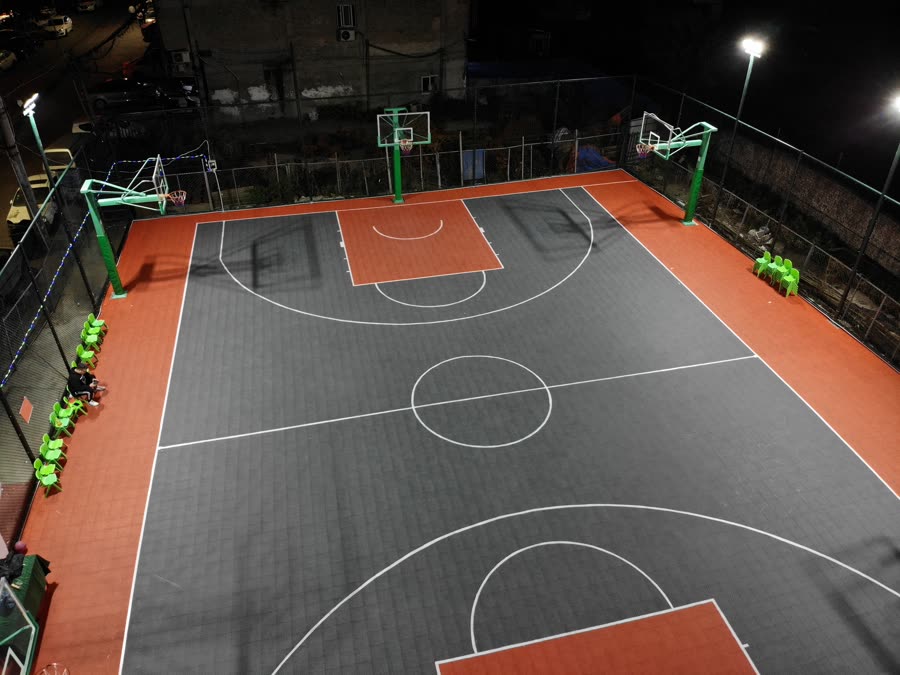
Yongjia Tangtou Court (delivered in 2021) — in use for 5 years to date, in good condition with regular maintenance
So which material should I actually choose?→ Material comparison · Selection (suspended vs. acrylic/silicon PU/PVC…)
| Action | Cycle | Tools | Duration |
|---|---|---|---|
| Surface cleaning | Weekly | Soft-bristle broom | 10 minutes/100 m² |
| Seam sand cleaning | Monthly | Soft-bristle brush / blower / high-pressure air gun | 30 minutes/100 m² |
| Lock Inspection | Quarterly | Visual inspection + hands-on feel | 1 hour/500 m² |
| Line-marking maintenance (sprayed-line version) | Every 2–3 years | Dedicated outdoor coating | 1 day/standard court |
| Expansion joint assessment | Annually (late spring) | Steel Ruler | 30 minutes/court |
| Localized replacement of damaged tiles | On demand | Pry bar + spare single tiles | 5 minutes/tile |
| Full-court deep cleaning | Annually | Soft-bristle brush + clean water | 4 hours/standard court |
Use a soft-bristle broom or a soft-bristle vacuum,Avoid using stiff-bristle or metal brushes, as it scratches the surface. Large debris such as fallen leaves and paper scraps can simply be swept away.
Sand and gravel embedded in the seams is the most common hidden hazard of suspended flooring. Sand and gravel cause uneven stress on individual tiles, which over the long term leads to:Bulging seams, loose locks, surface wear。
Basketball courts occasionally have oil stains (dirt from shoes, leaking maintenance agents); useNeutral cleaner + soft-bristle brushCleaning. Avoid strong alkalis, strong acids, and chlorine bleach (they corrode the PP surface).
| Fault | Reason | Treatment |
|---|---|---|
| Summer buckling | Insufficient expansion joints | Temporary fix: cut and release one row of single tiles; permanent fix: relay and add sufficient expansion gaps |
| Localized single-tile damage | External force impact / heavy object impact | Pry out the damaged tile with a pry bar and replace it with a spare tile |
| Loose Locks | Sand and Gravel Embedding / Lock Aging | Press back down after clearing the sand; aged locks need localized replacement |
| Bulging seams | Sand and Gravel Embedding | Clear the Sand + Check the Locks |
| Noticeable fading | UV exposure / inferior raw materials | Normal fading requires no action; for severe fading, contact the manufacturer for assessment |
| Standing water that won't drain | Bottom clogged with debris / insufficient base slope | Lift individual tiles to clean underneath; in severe cases, re-grade the slope |
We recommend purchasing 2–5% spare parts at the time of project delivery, stored in a dry, ventilated place:
Spare parts are mainly used for: replacing localized impact damage, swapping single tiles with color differences in line-marking areas, and occasional repairs after long-term use.A spare-parts inventory count every 5 years is recommended, for items aged over 2 years, we recommend treating them before reordering.
Take a standard 5v5 basketball court (420㎡) as an example:
At ¥50/hour labor = ¥1,150/year. Plus ¥200 tool wear + ¥500 spare-part reserve = Annual maintenance cost approximately 1,850 RMB, which is 2.3% of the initial investment (approximately 80,000 yuan).
By comparison, silicon PU courts need their surface layer redone every 5–8 years (cost ≈ 70% of the initial investment); acrylic needs recoating every 3–5 years (cost ≈ 30% of the initial investment).Suspended flooring has the lowest long-term maintenance cost。
If a problem arises and you're unsure how to handle it, you can refer to Installation & Acceptance Checklist trace back whether hidden risks were planted during the construction phase. Durability is also directly related to material selection; we recommend verifying Key Specifications of PP Interlocking Flooring; for replacement or additional purchase, you may refer to Key Points for Vetting Manufacturers in Yongjia, Wenzhou Confirm supply of the same model.
Yes, but with limitations.Keep pressure below 60 bar, more than 30cm above the ground, avoiding directly hitting the seams (which would loosen the locks). Deep cleaning is recommended just once a year.
Clear snow with a plastic shovel (not a metal one) or a soft-bristle broom. Avoid industrial salt (de-icing agents corrode the PP surface); use coarse sand or eco-friendly de-icers (calcium-based products).
Single-tile inlaid lines need no touch-up (using a single tile is the color itself); sprayed paint lines should be re-coated every 2–3 years with the same model of outdoor paint. Before touching up paint, thoroughly clean the underside to ensure adhesion.
Short-term yes (temporarily bonded with tape), but we recommendReplaced within 1 week. A damaged tile affects the lock engagement of its neighbors, and over time the damage spreads to 2–3 surrounding tiles.
Under normal use and regular maintenance, AnchorCare outdoor suspended flooring can reach an actual lifespan of 10–15 years. At the end of the 8-year warranty, you can contact the manufacturer for an assessment to decide on warranty renewal (supported on some models) or localized refurbishment.
Connect directly by phone with a technical consultant—free proposal + sample shipment + factory inspection report
📞 400-6065-611The maintenance page adds daily care, fading expectations, and warranty boundaries to help users avoid focusing only on service life.
Explains sweeping, lock inspection, stain treatment, partial replacement, and seasonal expansion-joint checks.
Explains outdoor color stability, material aging resistance, service life, and realistic fading expectations.
Clarifies the relationship between product warranty, installation responsibility, use cases, and after-sales communication materials.