How much per square meter is suspended interlocking sports flooring? Price range and budget checklist
Author: Ian | CTO
Clarifies the material cost, installation cost, and a three-material cost comparison for suspended interlocking sports flooring, plus complete budget examples and full-lifecycle costs for community basketball courts, 3x3, and campus courts. Prices are reference ranges; the final figure depends on the model, area, foundation conditions, and contract.
|
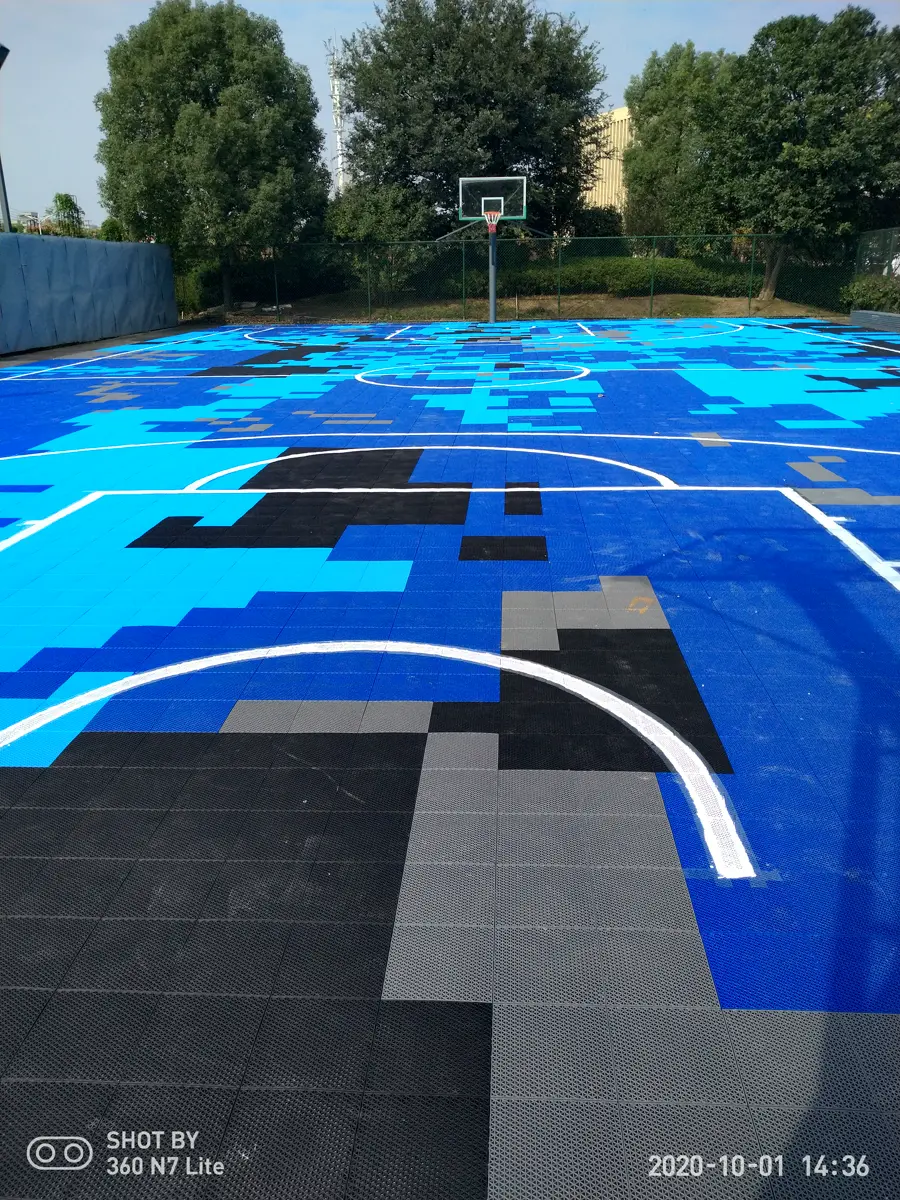
Nanchang Vanke Sports Park Multi-Purpose Court (delivered 2020)
Short answer:Modified PP suspended interlocking sports flooring'sMaterial cost mainstream range is roughly 120–280 RMB/㎡: Standard basic versions fall toward the lower end of the range, while premium versions with patented shock-absorption/anti-slip technology fall toward the upper end;On-site installation fee charged separately, approximately 20–40 RMB/㎡. A standard 30m×16m community basketball court (ANK5) has an overall budget of about 157,000 yuan, while a commercial 3x3 court runs about 40,000–70,000 yuan. Prices fluctuate with model, area, base conditions, and region.The contract confirmed by both parties shall prevail。
Professional basketball, 3x3, competition, and high-spec circulation venues
Around 220–280 yuan/㎡
The above are range positionings, not fixed quotes; the same model varies with thickness, color, area, and foundation, and the contract shall ultimately prevail.
Must comply with GB 36246-2018, we recommend choosing models that have passed campus testing, such as ANK2F/ANK5;
For large areas (5,000 m²+), the unit price can be reduced; specifics depend on the area and foundation conditions, subject to the tender/contract — see reference Bid technical parameters。
6 factors that affect price
Raw Material: Virgin modified PP vs. recycled material — the price difference is significant and directly affects weather resistance and lifespan
Structure: Single-layer vs. true triple-layer iBoost shock absorption; the patented structure costs more
Specification thickness: 25×25 / 50×50cm, with different thicknesses corresponding to different weights and unit prices
Technology bonus: Whether it includes patented technologies such as Anti-Slip, shock absorption, and antibacterial properties
Area: The larger the area, the more room for a lower unit price
Base and logistics: Whether the base needs leveling, plus the city and shipping distance
Don't just compare unit price: calculate the 8–10 year full lifecycle cost
The annual maintenance cost of suspended interlocking flooring is about that of the initial investment 2%–3%(for a venue costing about 80,000 yuan, annual maintenance is about 1,850 yuan), and its life can be extended by replacing tiles locally — see Daily maintenance feature。
By comparison, acrylic needs recoating every 3–5 years (cost ≈ 30% of the initial investment), and silicon PU needs its surface layer redone every 5–8 years (cost ≈ 70% of the initial investment). Once maintenance and renovation are factored in,The Long-Term Total Cost of Suspended Flooring Is Usually the Lowest。
When comparing prices, we recommend a consistent basis: the combined total of materials + installation + accessoriesFinished price, then add full-lifecycle maintenance, rather than only comparing the material price per tile or per square meter.
FAQ
How much per square meter is suspended interlocking sports flooring?
Mainstream modified PP suspended interlocking sports flooring costs about 120–280 RMB/㎡, with standard models toward the lower end of the range and patented shock-absorbing/anti-slip models toward the upper end. On-site installation fees are charged separately at about 20–40 RMB/㎡. The final unit price varies with model, area, base conditions, and contract, and shall be subject to the contract confirmed by both parties.
Why do suspended floors vary so much in price despite being the same?
The price difference mainly comes from: raw material (virgin modified PP vs recycled material), structure (single-layer vs true three-layer shock absorption), specifications and thickness, whether patented anti-slip/shock-absorption technology is included, inspection and certification coverage, as well as construction differences caused by area and foundation conditions. Low prices often correspond to recycled material or thin sheets, and the full-lifecycle cost is not necessarily lower.
About how much is the budget for a standard community basketball court?
Take a 30m×16m community multi-purpose court as an example: using ANK5 basketball grid at about ¥150/㎡, together with hoops, fencing, line-marking, and construction, the overall budget is about ¥157,000 (tax and auxiliary materials included, fluctuating with region and configuration). A commercial 3x3 court is about ¥40,000–70,000. The actual on-site quote shall prevail.
Suspended Flooring, Acrylic, or Silicone PU—Which Is More Cost-Effective?
Unit price: acrylic at 80–120 yuan/㎡ is the lowest, suspended flooring at 120–280 yuan/㎡, silicon PU at 180–260 yuan/㎡. But you must calculate the full life cycle: acrylic needs recoating every 3–5 years (≈30% of the initial cost), silicon PU needs the surface layer redone every 5–8 years (≈70% of the initial cost), while suspended flooring carries an 8-year warranty, allows partial replacement, and has annual maintenance of about 2%–3% of the initial investment — the lowest long-term maintenance cost.
Why do you need specific venue information to provide a quote?
An accurate quote requires the area, city, base type (concrete/asphalt/existing surface), use case (campus/community/competition), model preference, and delivery time. These directly affect material model, installation volume, and logistics; only with these can we give an installed completion price rather than just a per-tile price.
Want an accurate quote for your venue?
Provide the area and city, and our technical consultant will produce a free plan + budget list + factory test report
Use the short video to learn about the structure, installation, maintenance, and warranty of suspended flooring, helping you decide where to invest your budget.
Material comparison
Which Is Better, Suspended Flooring or Synthetic Surfacing (Part 1)
From the perspectives of construction period, foundation requirements, and later maintenance, first clarify the primary differences between suspended modular flooring and traditional plastic/rubber surfaces.
Material comparison
Which Is Better, Suspended Flooring or Synthetic Surfacing (Part 2)
Continue comparing drainage, renovation, cost, and user experience to help campus, community, and kindergarten projects decide whether interlocking flooring is suitable.
Base knowledge
What is suspended flooring
Introduces the interlocking structure, raised base, drainage channels, and common sports scenarios of suspended modular flooring.
Use the short video for a quick explanation of the advantages of glue-free interlocking installation, drainage, partial replaceability, short construction time, and suitability for multiple scenarios.